Space, without your own satellite. Explore the Mission Finder →

← All mission examples

Two models. One orbital test.

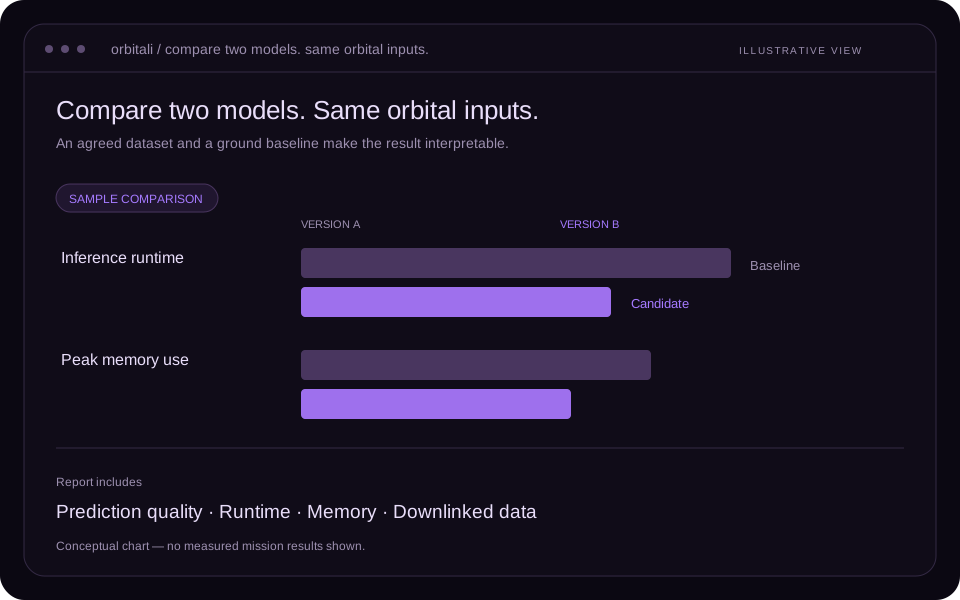
An example of how an Earth observation team could compare model quality, runtime and memory use without building its own test satellite.

Plan a similar mission ↗
Two models. One orbital test.

“We have two cloud detection models. Before choosing one for our next mission, we need to know how they perform on a compatible orbital computer.”

An example brief, not a customer quotation.
01 / THE TASK

What needs to happen

Evaluate two model versions against the same set of 100 approved images.

02 / THE CAPACITY

What you would rent

A compatible onboard computer, access to the agreed image dataset and a downlink allocation.

03 / THE RESULT

What comes back

Predictions from both versions, runtime and memory logs, and a concise comparison report.

Buy the test.
Rethink the launch.

For this example, assume the following two routes to the same software test. The shared route depends on an existing payload being suitable.

DEDICATED MISSION ROUTE

Build around your own spacecraft

€200,000illustrative project budget
6 monthsillustrative planning runway

You coordinate a dedicated spacecraft or payload, integration, launch access and operations. This route offers more control over hardware and mission design.

SHARED CAPACITY PILOT

Use a compatible satellite

€30,000illustrative all-in pilot budget
7 daysexecution target after approval

Your budget covers an assumed scope of integration, payload access, execution, data return and reporting. The existing operator retains spacecraft control.

Read these numbers as scenario inputs.

They are not market benchmarks, operator quotes or measured customer savings. The dedicated route may cost more or take longer. The shared execution target starts only after compatibility checks, integration, operator approval and capacity confirmation; that preparation adds lead time. Actual scope, pricing and schedule must be agreed before a real mission.

Bring the right inputs.

  • Two versioned model packages and their dependencies.
  • 100 approved image inputs, with labels where a quality comparison is required.
  • A ground baseline and clear acceptance criteria.

One task. The right resources.

Payload compute

Enough execution time for both models and repeat runs.

Data access

The same approved image set for both versions.

Result downlink

Predictions, logs and the agreed comparison report.

How the mission would run.

01

Prepare

Freeze both model versions and the input dataset. Document the ground baseline.

02

Confirm compatibility

Check processor architecture, runtime, memory and data permissions with the operator.

03

Run the comparison

Execute the approved workload in an available window and collect the specified metrics.

04

Review the evidence

Compare outputs and resource use. Identify what the test does and does not prove.

Why shared capacity fits

The team needs evidence about software on an existing payload. It does not need a custom camera or ownership of the spacecraft.

The boundary of this test

A shared test gives you access to approved payload resources. It does not replace end-to-end qualification of a new satellite, and the execution target starts only after integration, approval and capacity confirmation.

What would your team test?

Start with your objective. Build a mission brief around the capacity you actually need.

Explore this mission in the platform ↗

Interactive preview. Sample capacity and planning tools; live operator bookings are not connected.